

A burst supply line under a kitchen sink can run for six hours before anyone notices. By then the subfloor is soaked, the cabinets are swelling, and you’re looking at a repair bill you didn’t plan for. I’ve bought houses across Oregon with exactly that story behind them, from Gresham ranch homes to Albany bungalows. Water damage isn’t the end of your sale. When you sell a water-damaged house in Oregon, the damage changes the route, not the destination. The sooner you know your options, the more control you keep.
Can You Sell a House with Water Damage in Oregon?
According to Redfin, the median sale price across Oregon in October 2026 was $497,914, about 2.4% below the year before, and homes sat a median of 40 days on the market. Those numbers describe dry houses. Yours still sells, just to a smaller pool of buyers who price the repair into their offer.
Oregon law doesn’t stop you from selling a property with active or past water damage. You can list it, auction it, or sell it directly.
The one thing you can’t do is hide it.
Paying cash means buyers don’t need a lender’s blessing, so a soggy crawlspace in Keizer doesn’t sink the sale. Buyers using a mortgage loan face a harder road, since appraisers and underwriters both get a vote.
Some time ago I worked with a couple in Milwaukie splitting assets in a divorce. For two winters, a slow roof leak had stained the upstairs ceilings, and neither of them wanted to run contractors from separate apartments. We closed without either one setting foot in the house again.
Oregon’s weather deserves some of the blame. Rain falls somewhere in the Willamette Valley through most of November to March. Older houses built before modern vapor barriers soak it up through foundations, siding seams and worn flashing. Coastal properties in Lincoln City and Astoria get salt air on top of the moisture. East of the Cascades, Bend and Redmond homes see less rain but more pipes that burst in a hard freeze.
Selling with water damage in Oregon means picking the buyer who can handle the condition. That’s usually an investor, a contractor, or a homeowner with cash and a tolerance for mess.
What Oregon Law Says About Disclosing Water Damage
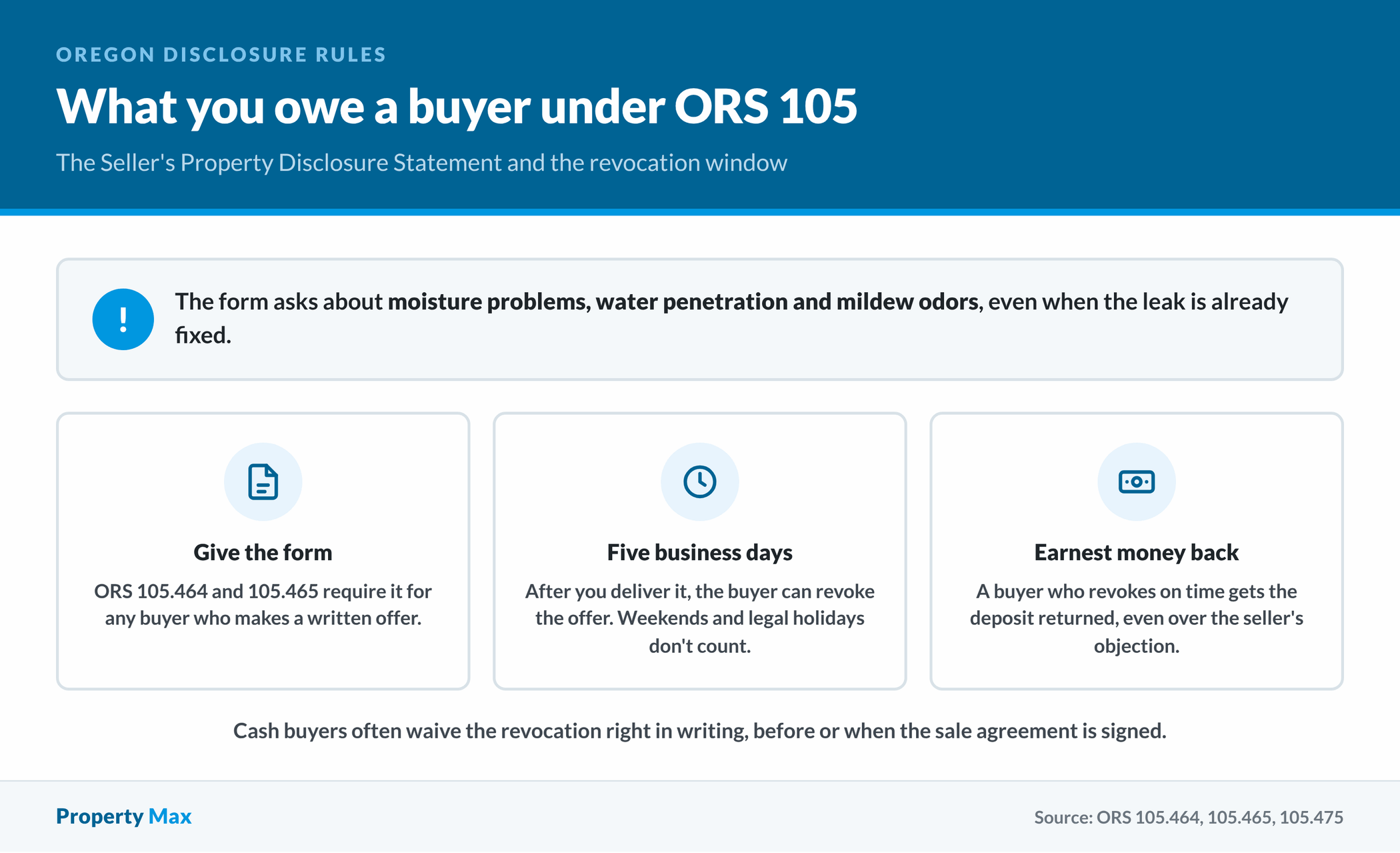
Do you have to tell a buyer about a leak you already fixed? Yes, in most cases. Oregon’s Seller’s Property Disclosure Statement asks direct questions, and a repaired problem is still a problem that existed.
Oregon law under ORS 105.464 and 105.465 requires sellers to give a Seller’s Property Disclosure Statement to any buyer who makes a written offer. The form itself asks whether there are moisture problems, areas of water penetration, and mildew odors. A separate question asks about material damage to the property from natural causes, with floods and landslides on that list. You’ll find the full statutory form on the Oregon Legislature’s site.
Answer honestly. Writing a vague “unknown” on a question you clearly know the answer to invites trouble later.
Your timeline changes the moment you hand over that disclosure. Under ORS 105.475(1), the buyer can then revoke their offer by giving you a signed written notice. The window runs five business days, not calendar days, so Saturdays, Sundays, and legal holidays don’t count. If a buyer revokes on time, they’re entitled to the immediate return of their deposits, earnest money included. Escrow has to send that money back even if you object.
Some sellers don’t have to use the form at all. The statute excludes certain sellers appointed by a court, such as personal representatives and trustees. If you’re selling as an estate representative, ask your real estate attorney whether you qualify before you fill anything out.
I’ve watched plenty of Oregon sales go sideways, and over-disclosing water damage has always cost sellers less than under-disclosing. Hand buyers the plumber’s invoice and the moisture reading. Paperwork on a repaired leak reads as competence. Surprises found during inspection read as concealment, and that’s when the price talks turn ugly.
Why Water-damaged Homes Are Hard to List Traditionally
“My agent says we’ll just price it low and someone will bite.” That works more often in theory than in escrow. The obstacle usually isn’t the buyer’s willingness; it’s the lender standing behind them.
Conventional and FHA underwriters want a habitable property. Visible mold, a flooded basement, or stained ceilings in the appraisal photos can trigger a list of required repairs before funding. Your buyer then needs the repairs done before closing, except the repairs are on a house they don’t own yet. That standoff kills sales.
Showings create a second problem. Musty odor is the first thing people notice walking into a Salem split-level with a damp crawlspace, and no amount of staging covers it.
Statewide supply tells you what you’re up against. Redfin counted 20,029 homes for sale in Oregon in October 2026, a few more than the year before. With that many choices, buyers can pick a house that’s already dry and skip the one with water damage.
Portland moves faster than the state as a whole. Redfin put the city’s median sale price near $525,000 for the three months ending October 2026, and homes sold after about 26 days on average. Water-damaged listings in Southeast Portland won’t keep that pace, because the buyers moving that fast have clean financing and high standards.
Agents carry a disclosure duty of their own. Any good Oregon broker will flag water damage on the property in the MLS remarks, and those remarks filter your buyer pool before the first showing.
Six months of carrying costs adds up fast. Mortgage, insurance, utilities, and property taxes keep running as you wait for the right buyer to appear.
How Much Does Water Damage Lower Your Oregon Home’s Value?
Buyers don’t deduct just the repair estimate. They deduct the repair estimate plus a risk premium for everything they can’t see behind the drywall. The second number is often larger than the first.
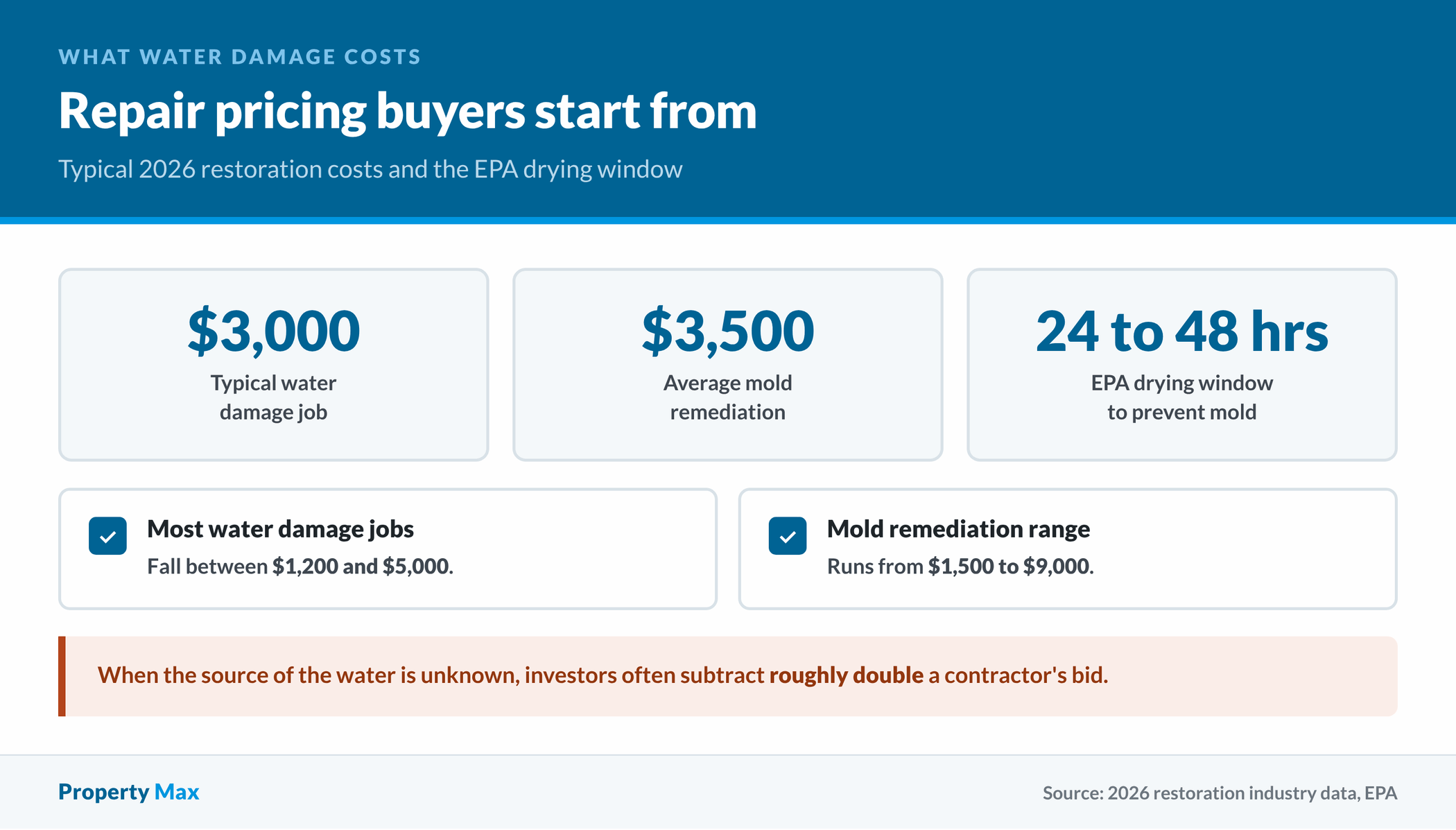
Repair pricing gives you the baseline. Restoration cost guides for 2026 put a typical water damage job at $3,000, with most between $1,200 and $5,000. Professional mold remediation averages $3,500 and runs from $1,500 to $9,000. The EPA says water-damaged areas need drying within 24 to 48 hours to prevent mold. Catch a leak the same day and it costs far less than one found weeks later.
Scale changes the math. One bathroom’s water damage is a line item; a crawlspace that’s been wet for three Oregon winters is a structural question involving joists, sill plates, and sometimes the foundation.
Appraisers in Oregon handle this with a cost-to-cure adjustment, subtracting the estimated repair from the as-repaired value. Buyers go further. I’ve watched investors subtract roughly double a contractor’s estimate when nobody knows where the water damage came from. The one thing worse than a $20,000 repair is opening a wall and finding a $45,000 repair.
Location changes how hard the hit lands. Local MLS data put Lane County’s median single-family price at $459,150 in October 2026, down 4.4% from a year earlier. In a softening market like that, a damaged property competes against plenty of sound houses. Hot pockets like Bend’s Old Mill District or close-in Northeast Portland hold value better, since the land carries more of the price.
Disclosed, documented water damage with receipts typically costs you less in negotiation than mystery stains.
Paper is worth real money at the closing table.
Should You Repair Water Damage Before Selling?
Fix it or sell it wet is the choice every seller in this spot ends up making. My answer depends mostly on whether the water is still active.
Stop the source no matter what you decide. Every week the leak runs, the problem grows and your offers shrink. Insurance companies in Oregon also get skeptical about claims where the homeowner knew and waited.
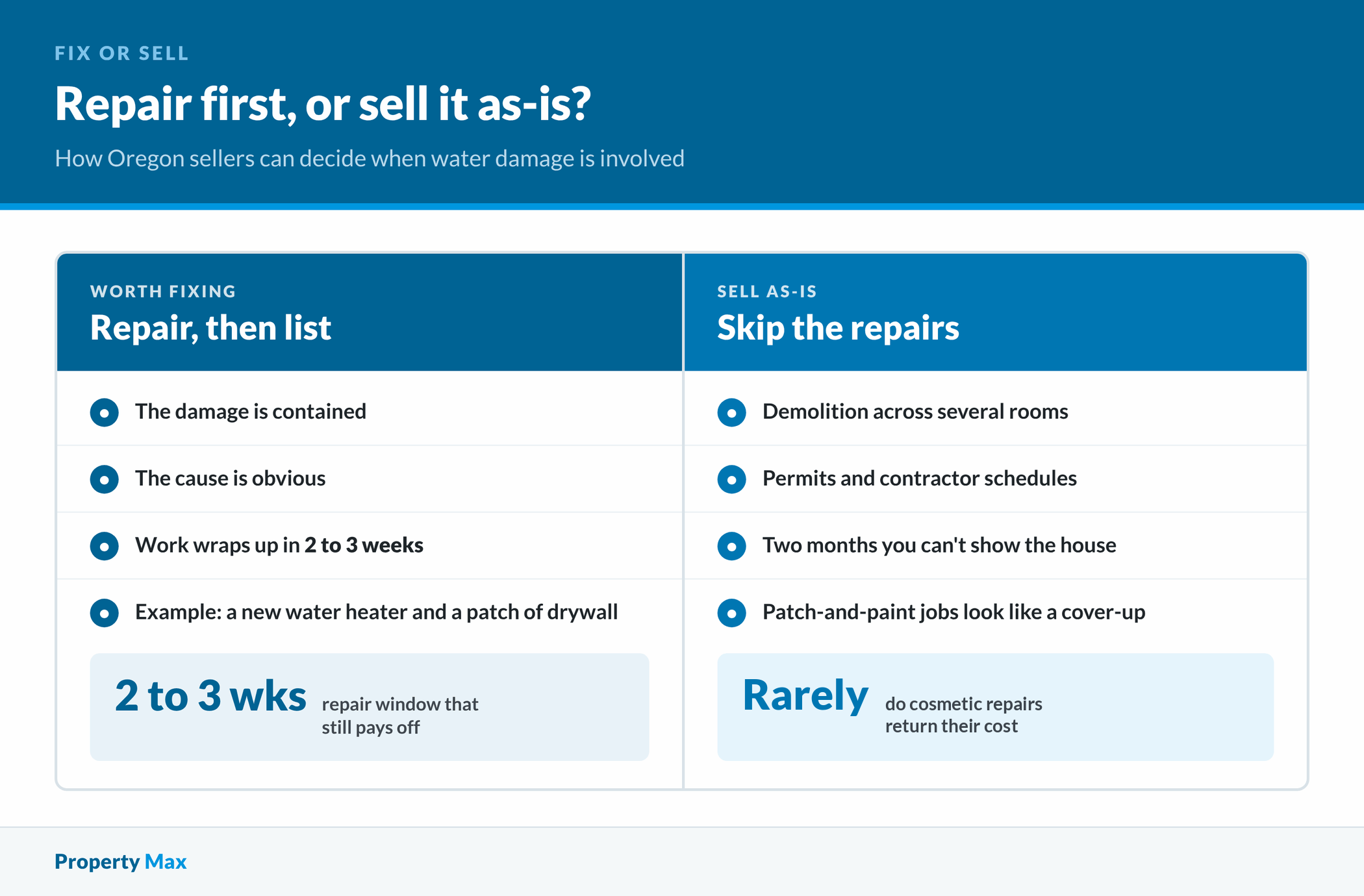
Past that, run the numbers. Repairs make sense when the damage is contained, the cause is obvious, and you can finish in two or three weeks. Take a replaced water heater and a section of drywall in a Hillsboro townhouse. I’ve seen that exact job turn a hesitant buyer into a full-price offer, so fix it and list it.
Repairs stop making sense once you’re into demolition. Pulling flooring across three rooms in a Medford rental means permits, contractor schedules, and a property you can’t show for two months.
Meanwhile your mortgage keeps billing you.
Partial repairs are the worst of both worlds. Patch and paint over water damage without fixing the source, and you’ve handed the buyer’s inspector an easy find. Now the fresh paint looks like a cover-up rather than upkeep.
Read your insurance policy before you spend your own cash. If your policy covers the loss, an insurance claim can fund restoration that raises your sale price by more than your deductible. Sudden pipe bursts tend to qualify. Long-term seepage and flood damage usually don’t, which is why separate flood coverage matters in places like Tillamook and the lower Columbia.
Selling as-is to a company like Property Max skips the repair decision. We buy Oregon properties in current condition, so the water damage becomes our project and our budget instead of yours.
One pattern I keep seeing: sellers pour five figures into repairs hoping for a bigger bump, then discover the market credits them less than they spent. Cosmetic improvements rarely return their cost on a house that still carries a water damage disclosure.
How Does a Direct Sale Handle Water Damage?
For years I assumed every seller I met wanted the highest number on paper, so I’d lead with price. Most of them actually want two answers first. What will the damage cost them, and when can they stop paying for it?
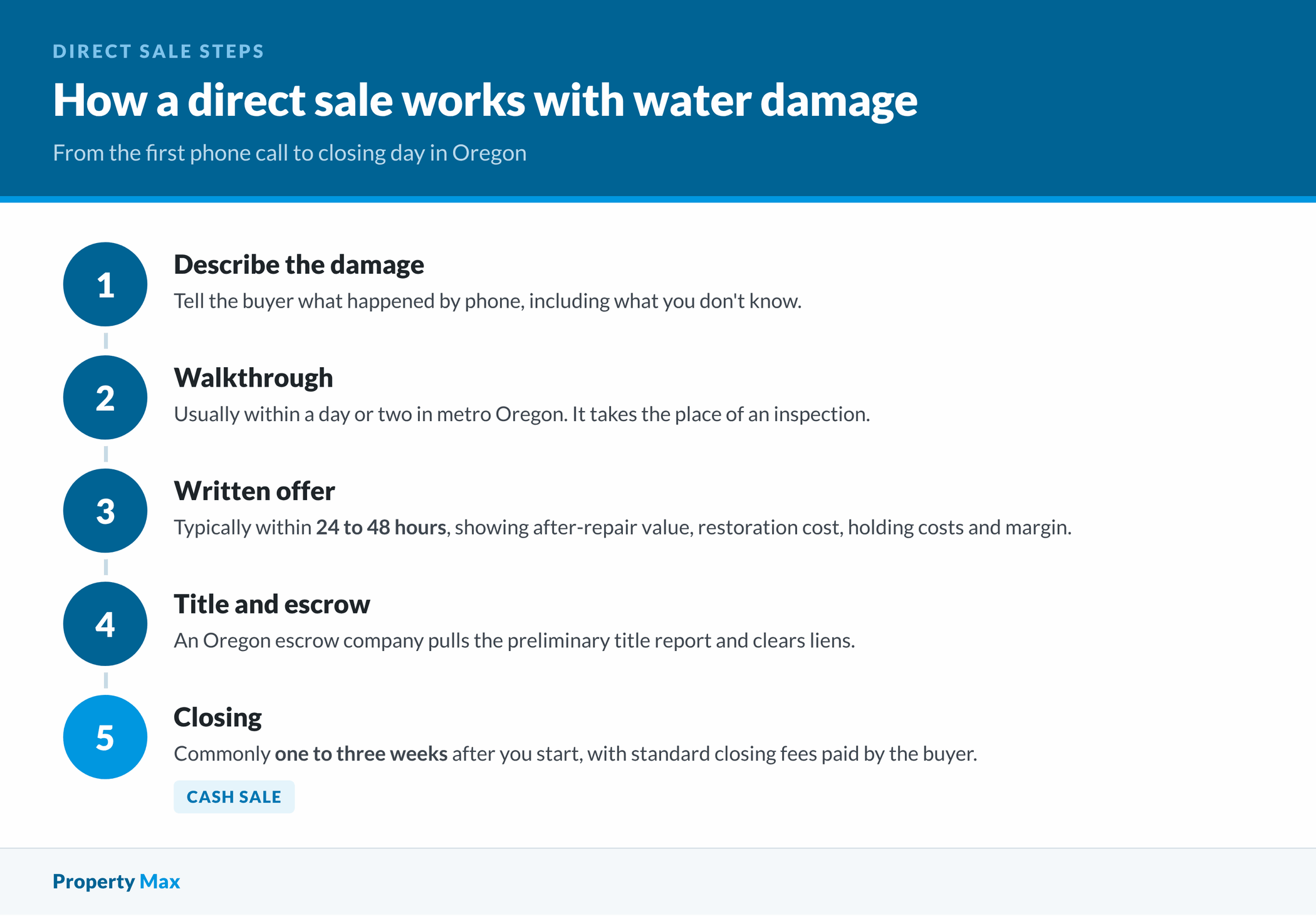
A direct sale starts with the water itself. You tell the buyer where it came from, how long it ran, and what’s been dried, replaced or left alone. Share the unknowns too. Next, a buyer walks the property, usually within a day or two in metro Oregon and a bit longer out toward Roseburg or Oakridge.
The walkthrough is the real inspection. A careful buyer checks under sinks, around the water heater and below stained ceilings, then looks in the crawlspace for standing water, sagging insulation and dark joists. No appraisal follows, and no lender sends a list of repairs.
Offers usually come soon after the walkthrough, and a fair one shows its work: after-repair value, the cost to dry out and restore the house, holding costs, and the margin. Ask how they priced the water damage itself. If a buyer won’t explain the number, keep calling around.
Title work moves in parallel through an Oregon escrow company, which pulls the preliminary title report and clears liens. Wet subfloors and moldy drywall don’t show up on a title report, so the damage won’t slow this step.
You still sign a disclosure statement in most direct sales, and the moisture questions get the same honest answers. Many cash buyers waive the revocation right covered earlier. That waiver has to be a written statement from the buyer, and the form’s own notice places it at or before signing the sale agreement.
Timing is where this path earns its keep. Closings commonly land in one to three weeks, since the only real gate is clear title. A financed buyer adds 30 to 45 days of underwriting, and the lender may still want the leak repaired before funding.
On closing costs, most Oregon direct buyers, including us, pay standard closing fees, so the offer you accept is close to what hits your account. You also skip paying a restoration crew out of pocket while the house sits.
What Makes Our Water-damaged Home Offers Different
Sit down, tell me what happened, and don’t clean up first. I’ve walked through houses in Oregon with buckets under the ceilings and water damage spreading across two floors. Condition alone doesn’t decide whether I make an offer.
Our offers price water damage from actual Oregon restoration costs, not from a generic deduction. A wet crawlspace in Beaverton prices differently than a burst pipe in a Springfield rental, because the labor markets and the construction types differ.
We don’t retrade. Accept our number and that’s the number we plan to close at, unless the title report turns up something nobody knew about, like an old judgment lien.
You keep what you want and leave the rest. Soaked furniture, warped boxes in the garage, the stack of paint cans in the corner: we handle disposal, and you don’t pay for a dumpster.
A daughter settling her father’s estate in McMinnville called us about the water damage a failed washing machine hose had left along one wall. Nobody had noticed the leak for months. Her father’s woodworking tools still filled the garage, and she told me they felt harder to face than the water damage. We closed on a Tuesday with those tools still sitting on the bench.
Your Oregon property doesn’t need to be photogenic, empty, or dry. It needs an honest description and a clear title.
If you’re sitting with a water-damaged house in Oregon and you’re not sure which direction makes sense, I’m happy to talk it through. Tell me what happened, what your timeline looks like, and what you’ve already spent. Maybe repairs and a traditional listing are your best move, and I’ll say so. If a direct sale fits better, Property Max can give you a straight number and a closing date. There’s no pressure and no obligation either way, just a talk with someone who has seen this a hundred times.
Frequently Asked Questions About Selling Water-damaged Homes in Oregon
Sellers with a water-damaged house in Oregon tend to ask the same handful of questions on the first call. These are the ones that come up most, answered the way I’d answer them at your kitchen table.
Do I Have to Tell Buyers About Water Damage That’s Already Repaired?
Yes, and the Oregon disclosure form is written to capture exactly that. Past moisture problems, water penetration, and material damage to the structure all get asked about directly, even if you’ve since fixed them. Attach the contractor’s invoice and any moisture readings to the form; a documented repair reassures buyers far more than a blank line does.
Will a Mortgage Lender Approve a Loan on an Oregon House with Water Damage?
Often not, at least not without conditions. Most lenders want the property habitable at closing, so visible mold, standing water, or compromised flooring can mean repairs before funds release. Buyers using cash, hard money, or private lenders don’t face that hurdle. That’s why direct buyers and real estate investors tend to be the ones making offers on damaged Oregon properties.
Should I File an Insurance Claim Before I Sell?
Check your policy’s coverage for the specific cause first. Sudden events like a pipe failure are usually covered, while gradual seepage and flooding generally aren’t. Also, flood damage typically needs a separate policy. If the claim is approved and the payout exceeds your deductible by a meaningful margin, using that money for restoration before selling usually improves your net.
Do I Need to Dry Out or Clean Up the House Before Selling?
Stop any active leak first, whatever you decide, because running water keeps growing the damage. After that, it depends on the buyer. For a traditional listing, the house needs to be dried and the musty smell gone before showings. A direct buyer takes it wet, stained and full of soaked belongings. Leave the cleanup and disposal to them, and keep any plumber’s invoices for your disclosure form.
Does Mold Change How I Should Sell?
It changes the buyer pool more than it changes the process. Mold growth can begin within a couple of days of a leak, so most older water damage in Oregon’s wet climate comes with at least some. Owner-occupant buyers tend to walk away rather than negotiate. Disclose it plainly, get a mold inspection if you want hard numbers, and focus your marketing on buyers who renovate for a living.
Is Selling As-is the Same as Hiding Problems?
Not at all. As-is means you won’t make repairs or offer credits for condition; it doesn’t waive your disclosure duty under Oregon law. You still fill out the disclosure statement and answer the water damage questions honestly. The buyer also keeps the statutory revocation window unless they’ve waived it in writing.
Selling a Water-damaged House in Portland and Across Oregon
Leaks and floods don’t take a house off our list. Property Max buys houses with water damage in the Portland area and in towns across Oregon. Redfin’s mid-year review put the Portland metro at 3.2 months of supply for the first half of 2026. With that many homes to pick from, buyers can skip the one that needs a restoration crew. That’s where a direct sale can help you.
On the west side, we buy houses in Beaverton with wet crawlspaces, stained ceilings and all.
Not near Portland? Check the areas we serve in Oregon to see if your town is on the list.
Talk With Property Max About Your Water-damaged Home
Tell us what happened, what you’ve priced out and when you’d like to move. We’ll walk the house as it sits, water damage and all, and give you a fair cash offer in writing. You’re free to take it, compare it or pass. When you’re ready, reach out to Property Max or fill out the short form below.
Helpful Oregon Blog Articles
- Can You Sell A House As Is Without An Inspection
- Selling a House With Solar Panels
- Do I Have To Sell My Home As Part Of Divorce In Oregon
- Average Cost To Sell A House In Oregon
- How Much Home Equity Do I Need to Sell My House
- How to Choose a Title Company
- How to Sell an Oregon Home with a Wet Crawl Space
- How to Sell an Apartment in Oregon
- How Long Does It Take to Sell a House in Oregon
- Can You Sell a Property With a Lis Pendens
- Sell House With Water Damage in Oregon