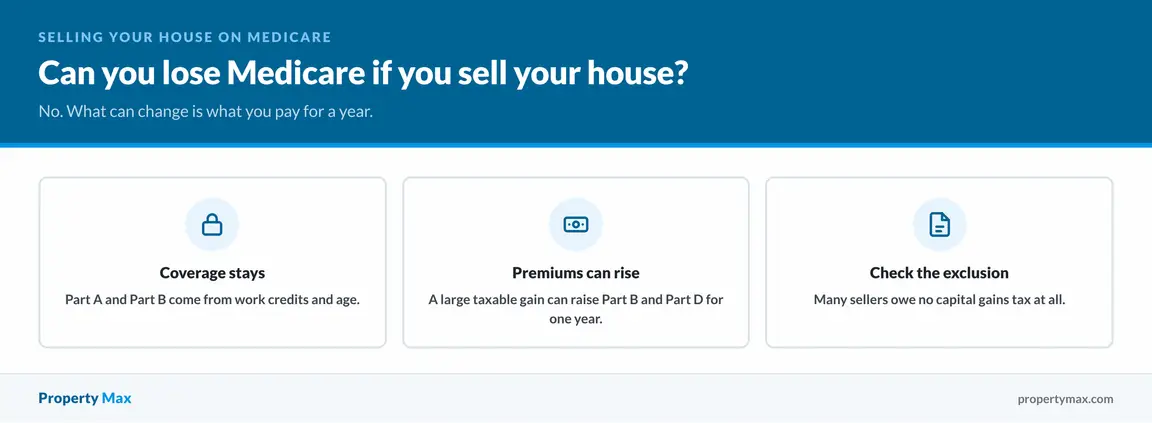

A woman called me once convinced that cashing out her house would cancel her health insurance. She’d been sitting on a paid-off three-bedroom for twenty-six years, terrified to sell, because a neighbor told her she’d lose Medicare the day the sale closed. Fear kept her in a house whose stairs she couldn’t climb. She was wrong about the rule, but she wasn’t wrong to worry, because something real does happen to your costs. You won’t lose Medicare because of a home sale. Your premiums, though, can jump for a year.
Will I Lose Medicare If I Sell My House?
An 81-year-old widower in Portland, Oregon spent four months convinced his Part B card would stop working the day he signed. He’d already packed half the kitchen before he called anybody who actually knew the rules.
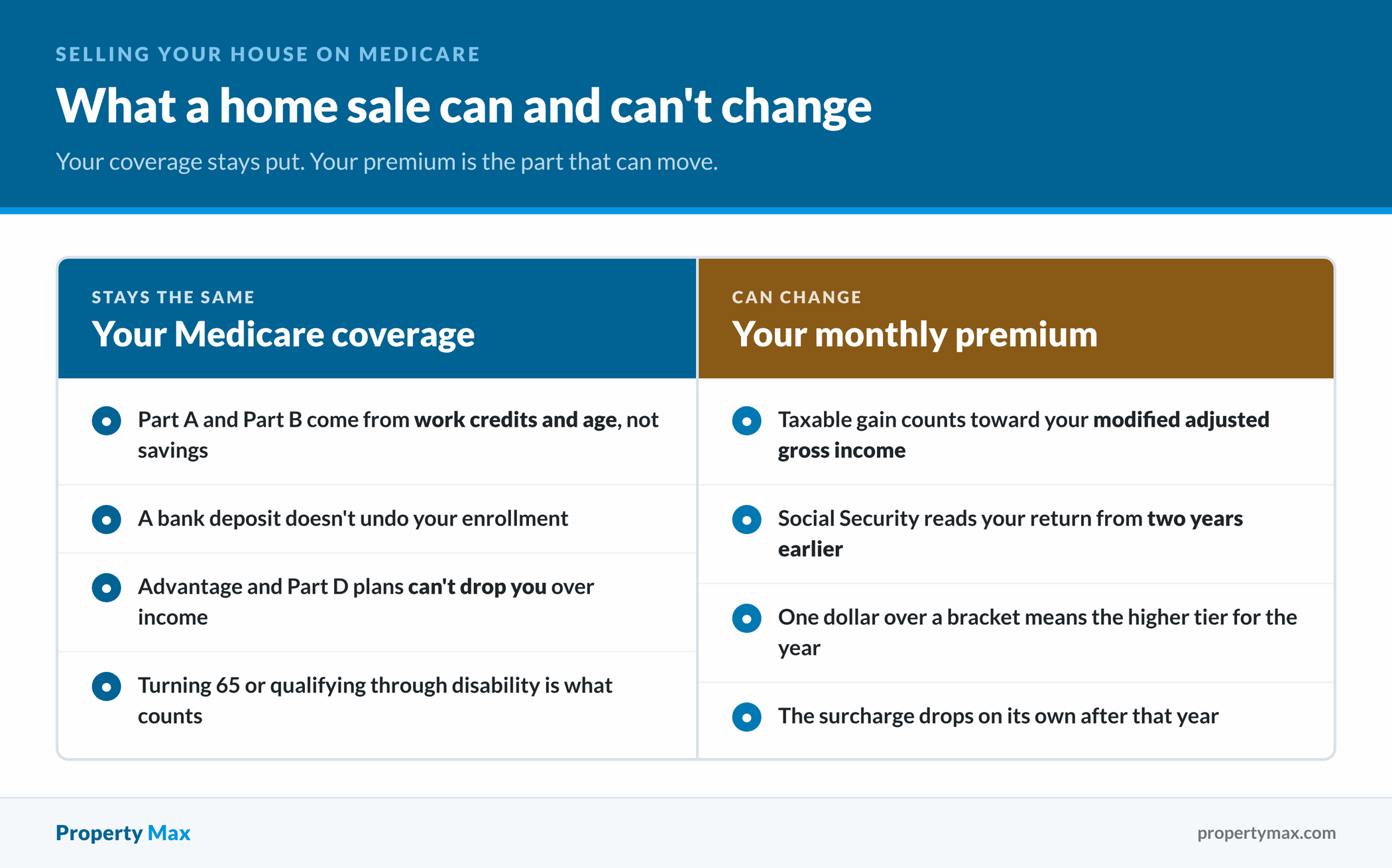
Medicare Part A and Part B aren’t need-based programs. You earned them through work credits and age, and a bank deposit doesn’t undo forty years of payroll tax. So no, you won’t lose Medicare if you sell your house, no matter how large the check is.
That answers the headline question. What follows is the part that costs money.
Your coverage stays, though your monthly bill might not. Social Security looks back at your tax returns from two years earlier to set what you pay, and a profitable sale can land you in a higher premium tier for twelve months. People conflate “my premium went up” with “I lose Medicare,” and those are completely different outcomes.
I bought a two-story colonial outside Salem, Oregon last year from a retired nurse who’d put off selling for two years. She was sure the check would make her lose Medicare. Her sewing room upstairs still had quilting patterns pinned to the wall. Once her accountant ran the numbers, she learned nothing would change, and she wished she’d called sooner.
The confusion mostly comes from people mixing up Medicare with Medicaid, which is a different program with asset limits that a home sale absolutely can blow past. One is insurance you qualified for by living long enough. The other depends on how little you own. Nobody explains that distinction at the closing table, and it leaves sellers guessing.
Does Selling Your Home Affect Medicare Eligibility?
Eligibility and cost are two separate conversations, and the internet mashes them together constantly. Selling won’t make you lose Medicare, yet plenty of sellers pay more for it.
Nothing about a real estate transaction touches the rules that got you enrolled. Turning 65 with enough work quarters, or qualifying through disability, is what put you on the rolls. Selling property doesn’t reverse either condition. You can’t lose Medicare by moving a deed.
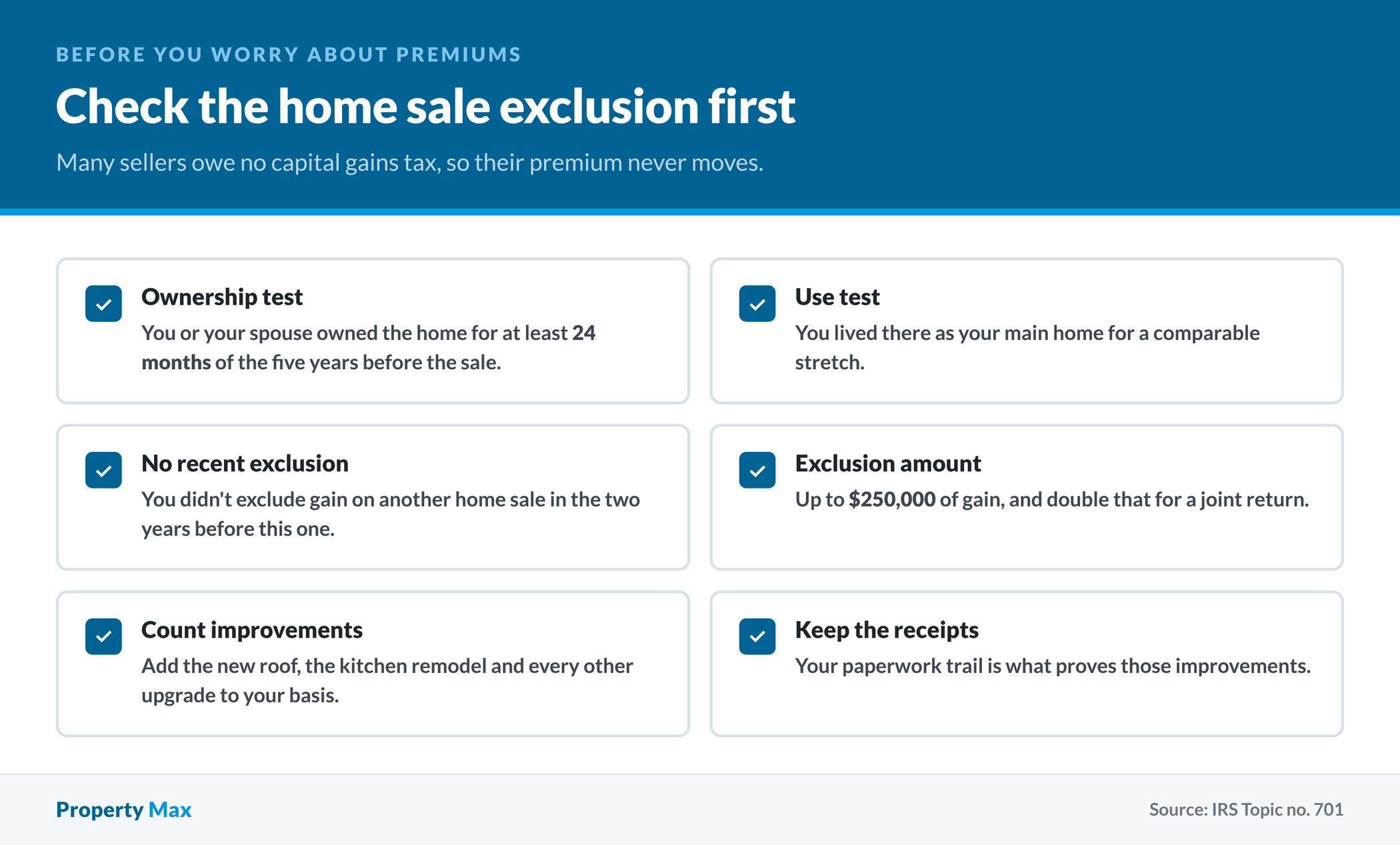
Where sellers run into trouble is the tax side. Profit from a sale counts toward your modified adjusted gross income for that year, and that figure drives your premium bracket. You may be able to exclude up to $250,000 of the gain on your main home from your income. Married couples filing a joint return can exclude double that, according to the IRS at Topic no. 701.
A retiring homeowner can know no more useful thing than that exclusion. Plenty of sellers never owe a dime of capital gains tax and never see their premium move at all.
Two things determine whether you qualify. Either you or your spouse must have owned the home for at least 24 months out of the five years leading up to the sale date. You have to have lived there as your main home for a comparable stretch. You’re generally not eligible if you already excluded gain from another home sale during the two-year period before this one.
Do the math before you panic. Subtract what you originally paid, add every improvement you’ve made over the decades, then subtract selling costs. Plenty of long-term owners still land under the exclusion ceiling once they count that new roof and the kitchen remodel, so the paperwork trail decides it. Receipts you threw away twenty years ago are the difference between a clean sale and a taxable one.
How a Home Sale Impacts Medicare Premiums and Costs
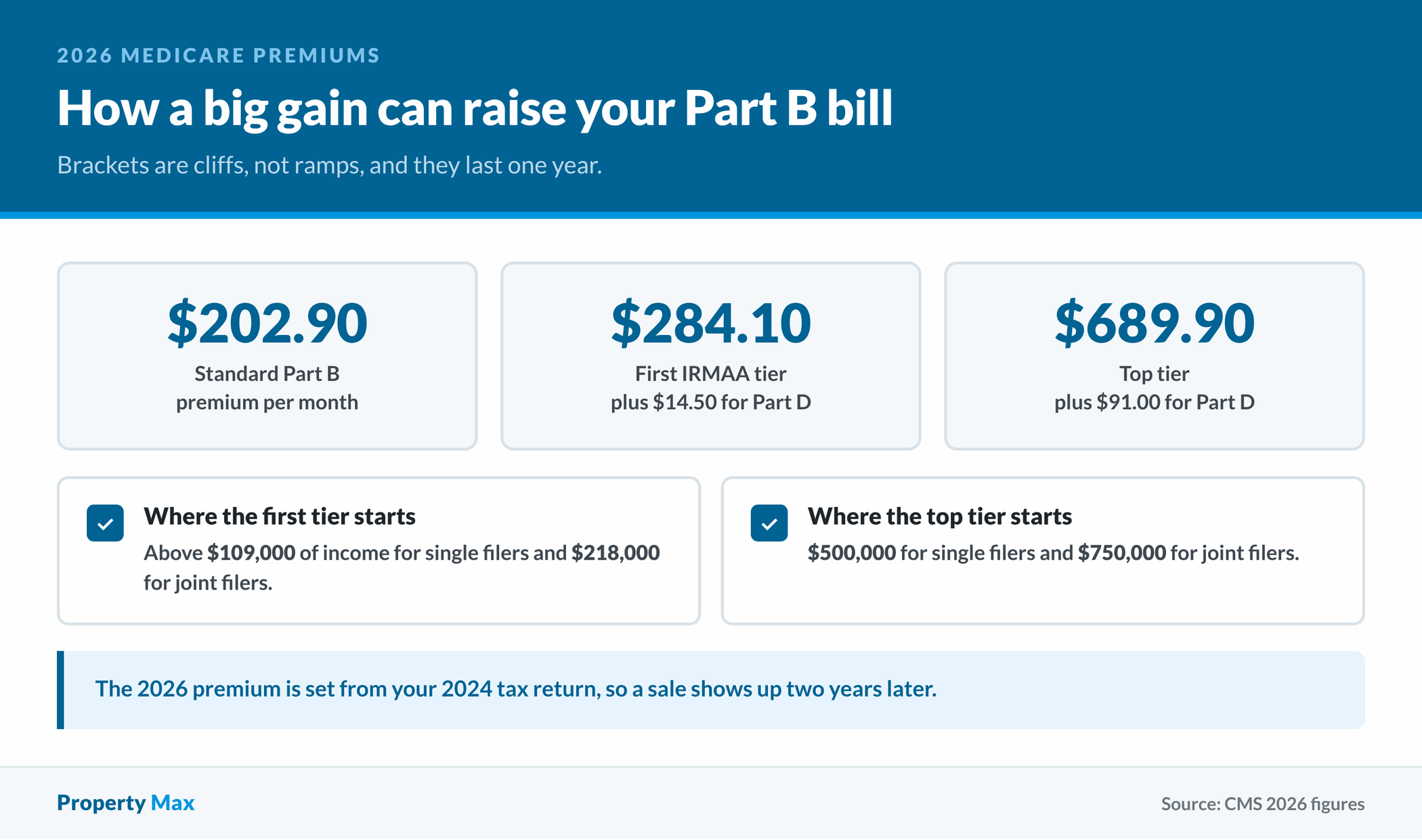
The surprise bill lives in that two-year lookback. Social Security uses your 2024 tax return to set your 2026 premium, which means a sale you closed years ago shows up as a higher number long after you’ve spent the proceeds.
IRMAA is the surcharge’s name, short for income-related monthly adjustment amount. The standard 2026 Part B premium is $202.90 per month, which was released by the Centers for Medicare and Medicaid Services in November 2025. For 2026, the IRMAA threshold starts at $109,000 of modified adjusted gross income for single filers and $218,000 for joint filers.
Cross that line and the bill climbs. Tier one puts the total Part B premium at $284.10 per person per month, and there’s also a $14.50 monthly Part D surcharge on top. The top tier starts at $500,000 for single filers and $750,000 for joint filers. There, Part B runs $689.90 monthly plus a $91.00 Part D surcharge, according to Medicare’s own income chart.
Sellers get one thing wrong about these brackets: they’re cliffs, not ramps. One dollar over a threshold moves you into the next tier for the full year.
A sale that produces taxable gain above your exclusion can push a retiree from the standard premium into tier one or two for twelve months, then drop them right back. It won’t make you lose Medicare and it’s temporary, but it’s still a few thousand dollars you didn’t budget for. Social Security sends it as a letter rather than a tax bill, so people miss it until the premium hits their check. You won’t lose Medicare over it, but you may spend a year paying for a house you no longer own.
Can you appeal it? Usually not for this reason. Social Security’s manual specifically lists a voluntary sale of income-producing property among the events that don’t qualify.
Can Selling Your House Make You Lose Medicaid Coverage?
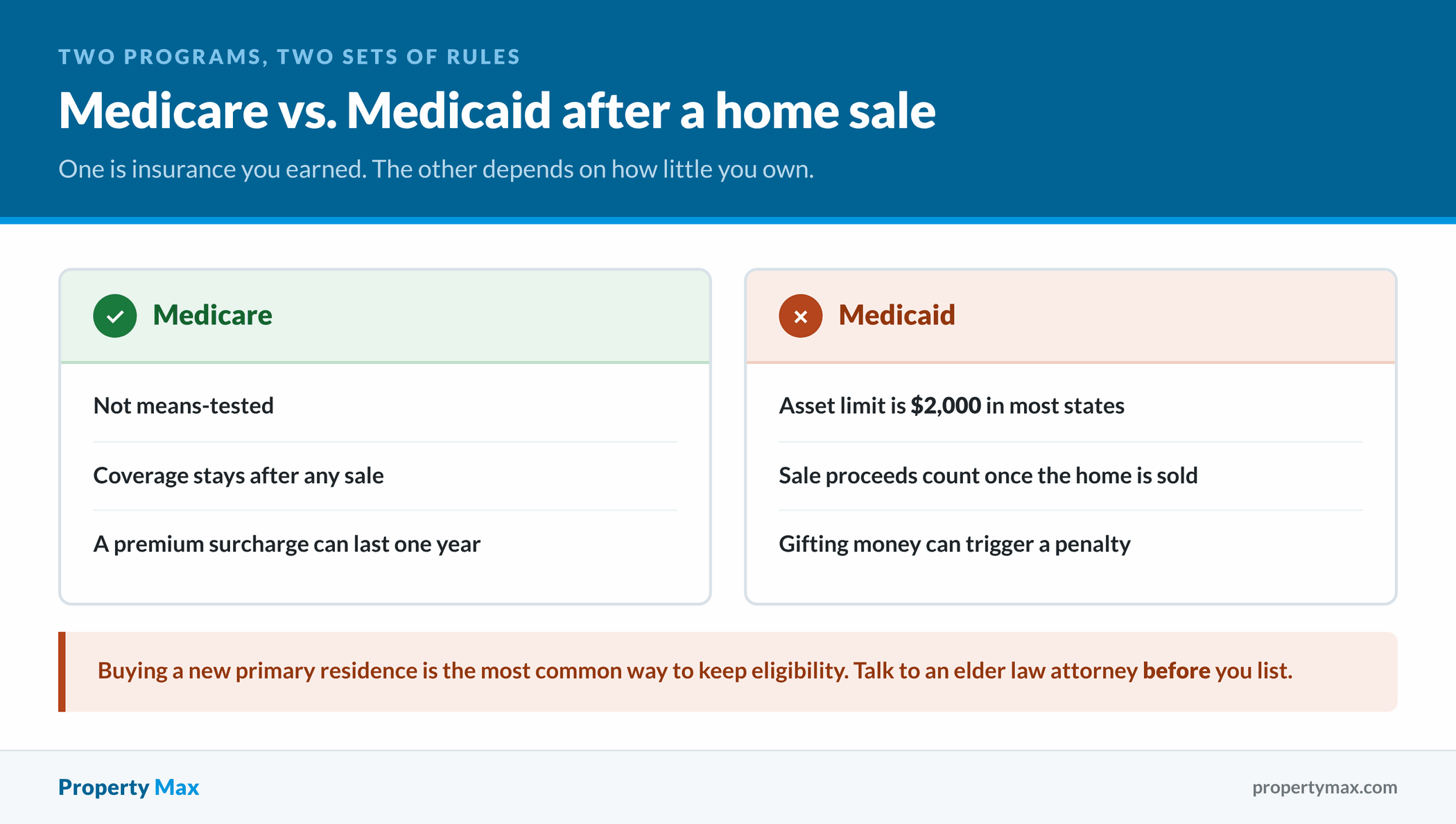
Medicaid is means-tested. Medicare never is, and nobody can lose Medicare over a bank balance. Medicaid sets an asset limit, and in most states that limit is $2,000. Once a home has been sold it’s no longer an exempt asset, and the proceeds count toward that limit.
If you’re dual-eligible, the sale can knock out the Medicaid half that pays for long-term care, while your Medicare stays put. You’d spend the excess down and reapply. Gifting proceeds to an adult child is the fastest way to create a penalty, since transfers get a hard look during the lookback period. Buying a new primary residence is the most common way to keep eligibility.
Talk to an elder law attorney before you list if Medicaid is in the picture. Not after. I’ve watched families close first and ask questions second, and the remedies available before a closing are far wider than the ones available after.
What Happens to Medicare for Specific Groups Who Sell Their House?
A retired schoolteacher owned her home free and clear and lived on about $38,000 a year. Her sale produced a gain well under the exclusion, her income barely moved, and her premium never changed by a nickel.
She didn’t lose Medicare or pay a cent more, and that’s the typical outcome. Most Medicare beneficiaries selling a long-held primary residence never approach the first IRMAA bracket.
Landlords are the group that gets hit. Rental property doesn’t qualify for the primary-residence exclusion at all, and depreciation recapture stacks on top of the gain. If you’re selling an investment property, assume a premium increase and plan for it. An installment sale spread across multiple tax years is worth asking your CPA about.
Married couples filing jointly often overlook that the exclusion doubles, giving them more room. Couples where only one spouse meets the use test get capped at the single-filer amount instead.
Heirs selling an inherited house are usually fine. A stepped-up basis resets the property’s value to its worth on the date of death, so a quick sale often generates almost no taxable gain. You don’t lose Medicare, and in many of these cases the premium doesn’t budge either.
Then there are people selling under pressure: medical bills, a looming move to assisted living, a mortgage they can no longer cover. In situations like that, speed outranks squeezing out the last five percent of value. A direct sale to a buyer like Property Max removes the showings, the repairs, and the uncertainty about whether a buyer’s loan will clear underwriting.
What’s your actual timeline? That question matters more than any tax bracket, because a sale that falls apart in February and closes in July can straddle two tax years and change your whole picture.
Key Questions About Losing Medicare After a Home Sale
$416,700 was the median existing-home price nationally in October 2026, according to the National Association of Realtors. It published the figure on November 12 and noted it ran 0.4% above the $414,900 recorded a year earlier. For a homeowner who bought in the 1990s, that number explains the anxiety: the gain on paper looks enormous.
Can you lose Medicare Advantage coverage over a sale? No. Advantage plans and Part D plans can’t terminate you over income, though your Part D surcharge can rise if IRMAA applies.
Does the sale get reported to Medicare directly? Not by your title company. The IRS shares your return data with Social Security, which is how the premium adjustment happens two years downstream.
One practical detail that saves people real money: time your closing with the calendar in mind. A December 28 closing and a January 4 closing land in different tax years, so if you’ve already got a high-income year behind you, pushing into January can keep you in a lower bracket. Houses are sitting a bit longer now anyway, with a median of 35 days on the market in October, up from 33 in September and 34 a year earlier. So you can usually find a few weeks of flexibility if you plan for it.
What if your premium already went up and you think it’s wrong? If the determination relied on outdated or incorrect data, you file Form SSA-561-U2 to request reconsideration within 60 days. Social Security also recognizes eight qualifying life-changing events on Form SSA-44. These are marriage, divorce or annulment, death of a spouse, work stoppage, work reduction, loss of income-producing property, loss of pension income, and receipt or termination of an employer settlement payment. A voluntary home sale isn’t on that list, so don’t count on that route.
Find a Medicare Plan That Fits After Selling Your House
Any premium increase triggered by a one-time sale corrects itself automatically. The standard recalculation happens when your next tax return is processed and matched to your Social Security record. So even a beneficiary who never files anything sees the surcharge drop on its own after paying it for the affected year. Nobody tells you that, and I’ve seen people spend money on advisors chasing a problem that expires.
A one-time sale won’t make you lose Medicare, but a year of higher premiums is still worth planning around. Annual open enrollment lets you switch Advantage plans or Part D coverage, and a plan with lower out-of-pocket costs can offset part of the surcharge.
If the sale is part of a bigger move, loop in your tax preparer before you sign a sales contract, not in April. The decisions that change your bracket all happen before closing.
If you’re selling because of medical bills or a move to assisted living, a direct buyer such as Property Max can close on your timeline. Your Medicare stays the same either way, so the premium is the only number to plan around.
Frequently Asked Questions About Whether You Can Lose Medicare After Selling Your House
How Do Capital Gains From a Home Sale Change My Medicare Premiums?
Taxable gain above your exclusion amount gets added to your modified adjusted gross income, and Social Security uses that figure two years later to set your Part B and Part D costs. If the total crosses a bracket threshold, you pay a surcharge for one year and then revert. You don’t lose Medicare, you just pay more for it temporarily.
Will Selling My House Raise My Part D Premium Too?
It can. When a sale lifts your income past an IRMAA threshold, Social Security adds a monthly surcharge to your Part D plan on top of the higher Part B premium. The surcharge follows the same income tiers as Part B. Your drug plan can’t drop you over it, and the extra charge ends once your income drops back down.
Can Selling My House Affect Extra Help or a Medicare Savings Program?
It can, because those programs help pay Medicare costs and look at what you earn and save. Your home doesn’t count, but sale cash does once it’s in your account. You won’t lose Medicare itself, though you may pay your own premiums until the money is spent down. Your state’s program office can tell you where you stand.
Can I Lose Medicare If I Sell a House I Inherited?
No. Your enrollment doesn’t change, and a quick sale usually keeps your premium where it is too. A stepped-up basis resets the home’s value to what it was worth on the date of death, so there’s often little taxable gain to push you into a higher tier. If you’re on Medicaid or a Medicare Savings Program, the sale cash is what to watch, so check with your state’s program office before closing.
Can I Lose Medicare If I Sell a Rental Property Instead of My Home?
Your enrollment is untouchable either way. What differs is the tax treatment, since investment property doesn’t get the primary-residence break, so the full gain plus depreciation recapture flows into your income for that year. That makes a premium surcharge more likely than it would be with a house you lived in.
Should I Delay Selling to Protect My Medicare Costs?
Rarely, since you can’t lose Medicare by selling. Paying a higher premium for twelve months is usually cheaper than carrying a house you can’t maintain, especially with taxes, insurance, and repairs running every month. Weigh the real holding costs against a one-year surcharge, and the arithmetic often favors selling now.
If you’re weighing a sale and trying to figure out what it does to your premiums, your timeline, or your peace of mind, we’re glad to talk it through with you. Bring your questions, even the ones you think sound silly. No pressure, no obligation, and no hard sell at the end of the call.