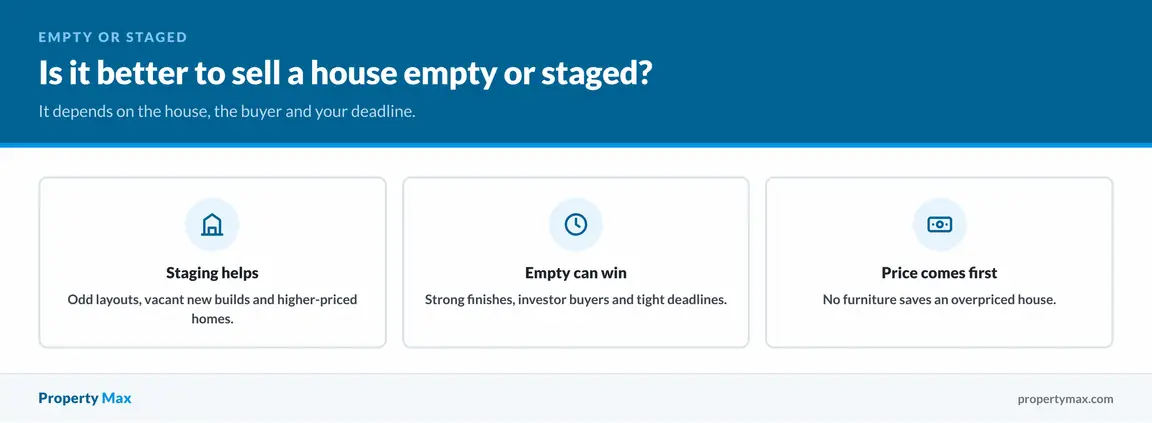

A buyer walked into a vacant four-bedroom one Saturday, stood in the middle of the living room, and asked me if a king bed would fit upstairs. The room was 16 by 14. She couldn’t tell. One question explains most of the empty or staged debate better than any study I could hand you. Buyers don’t measure, they imagine, and empty rooms give their imagination nothing to hold onto.
What Does Home Staging Mean for Sellers?
Most people picture a truck full of rented sofas. That’s one version, but it’s not the whole picture, and the gap matters if you’re weighing empty or staged for your own property. Home staging covers everything from a full furniture install in a vacant house to a two-hour walkthrough. On the short end, a stager tells you to pull half your furnishings out of the living room and repaint the hallway.
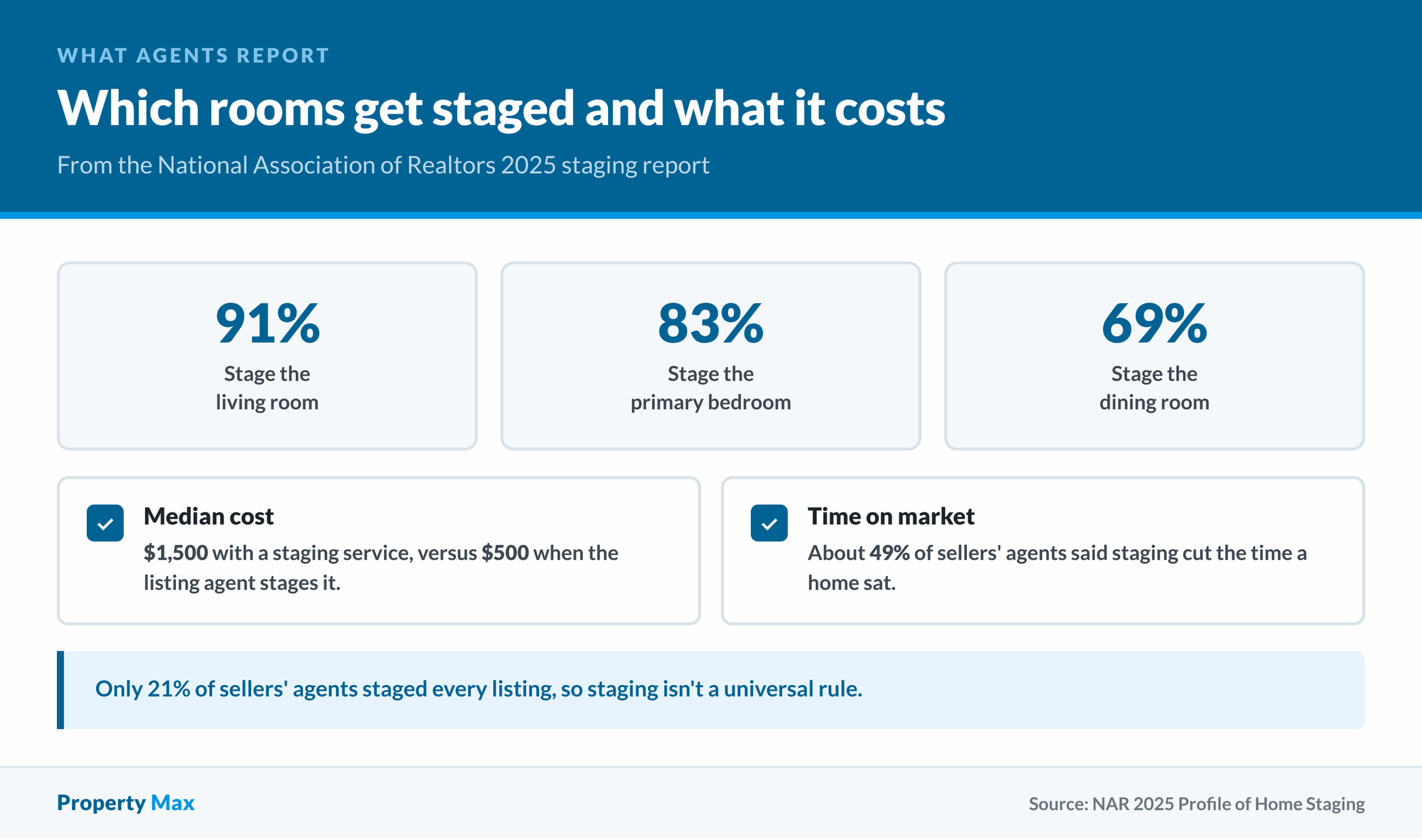
The National Association of Realtors surveyed agents in February 2025 for its staging report. Only 21% of sellers’ agents said they staged every listing before it went live. Another 10% said they staged only the homes that were proving hard to move. So staging isn’t a universal rule.
Which rooms get the attention? Living rooms top the list at 91%, followed by the primary bedroom at 83% and the dining room at 69%.
NAR pegged the median spend at $1,500 when a seller used a staging service, versus $500 when the listing agent handled it personally. That’s a threefold gap for what sounds like the same service. You can read the full report on NAR’s staging research page.
The word “staging” also hides a distinction that trips sellers up. Occupied staging works with what you own: your couch, your bedding, your art, rearranged and thinned out. Vacant staging means renting everything, so the bill climbs accordingly. Know which one you’re paying for before you sign anything.
Is It Better to Sell a House Empty or Staged for Top Dollar?
You pay a rental clock when staging a vacant home. The furniture doesn’t come free after month one, and if your house sits, you keep paying. Industry estimates put a vacant home staged with rented furniture at roughly $3,000 to $6,000 or more. Nobody puts that monthly line in the brochure when you’re weighing empty or staged, and it’s the piece that decides whether staging pays.
Now the upside. NAR found 29% of agents said staging raised the offers sellers got compared with similar unstaged homes. That’s under a third of agents, so a bump is far from guaranteed.
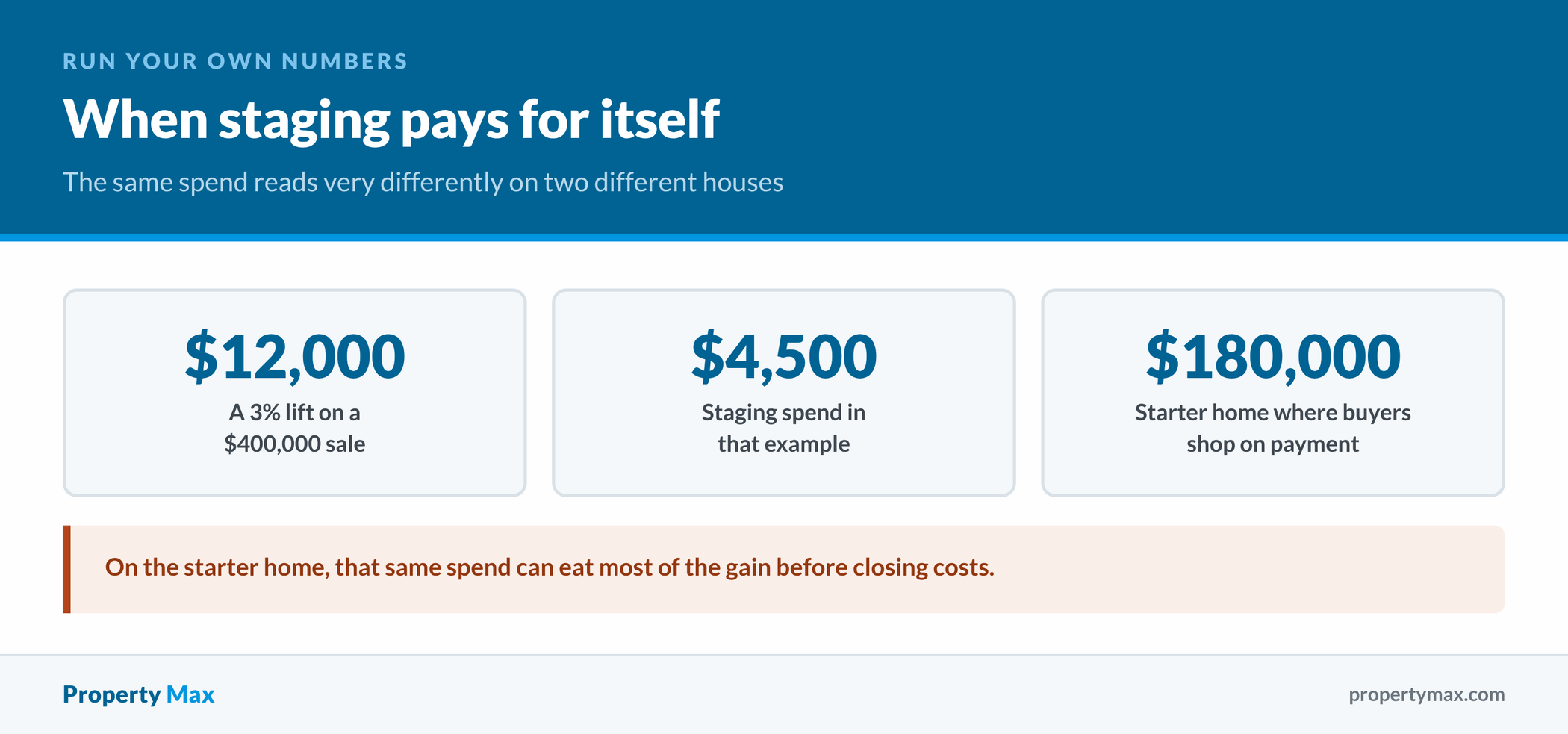
Run the numbers on a real house. On a $400,000 sale, a 3% lift is $12,000 against maybe $4,500 in staging. Good trade. On a $180,000 starter home in a neighborhood where buyers are shopping on payment, not presentation, that same spend eats most of the gain before you ever get to closing costs.
The trade isn’t automatically a good one. Deciding between empty or staged without running your own arithmetic is how people talk themselves into a $5,000 expense that never pays for itself.
Not long ago I worked with a young couple outside Beaverton, Oregon who were three months behind and already had an auction date on the calendar. Staging a house that was going to the courthouse steps in six weeks would’ve been absurd; they needed a closing, not a photo shoot. We got them one with the lawn mower still in the garage.
Your calendar settles most of this. If you’ve got four months and equity, staging is a legitimate investment. With five weeks and a deadline, it’s a distraction wearing a nice sweater.
Do Staged Homes Really Sell Faster Than Empty Ones?
Thirty-five days was the median time on market in October 2026, up from 33 days in September and 34 days in October 2025, according to NAR’s existing-home sales report. Sellers have less leverage than they did a year ago, and marketing choices carry more weight when buyers aren’t racing each other.
Does staging shorten that clock? Agents say yes, with hedges. About 49% of sellers’ agents reported that staging cut the time a home spent on the market. That’s still only about half, so faster isn’t a sure thing either.
Agents on the buying side sound more convinced. About four in five told NAR that staging helps a client picture living there, and plenty said buyers were quicker to book a showing on a house they’d already seen staged online.
Showings are the bottleneck. A buyer who scrolls past your listing never gets to the part where your floors are beautiful.
Inventory makes the empty or staged choice matter more right now. Supply climbed to 1.59 million homes and a 5.1-month supply in October 2026, with the national median price at $416,700. More competition on the shelf means your photos have to work harder than they did two years ago. You can check the current national figures in NAR’s October sales report.
My read on speed: the empty or staged choice matters most in the first ten days, when your listing is new and getting pushed to every buyer with a saved search. After that, price does the heavy lifting, so no amount of furniture saves an overpriced house.
Empty or Staged: Which Option Boosts Your Sale Price?
A retired teacher called me about her late mother’s house in Eugene, Oregon.
Her agent wanted the place emptied and professionally staged, but that would have meant a cleanout, a storage unit, and a rental install stacked back to back before a single photo got taken. Four to six weeks and several thousand dollars, all fronted by a seller who was already paying two mortgages.
Staging doesn’t lift every price equally. About 19% of sellers’ agents saw a bump of one to five percent, and fewer saw six to ten. My guess, from the houses I’ve walked, is that the big jumps land on pricier homes in hot pockets. Buyers there are comparing finishes, not square footage.
Furniture earns its keep in rooms with odd proportions. A long narrow bedroom with no furniture reads as a hallway. An open-concept great room with nothing in it feels like a gym.
And where does staging waste money? Homes that need a roof. Buyers notice the ceiling stain before they notice the throw blanket, and furniture never once distracted an inspector.
If you’re sorting through empty or staged for a property that needs work, the repair question comes first. Teams like Property Max buy houses in whatever condition they’re in, so staging and repairs come off the table entirely. It’s not the right answer for every seller, but it’s a real option worth pricing against a listing.
When Does Staging Make More Sense Than Leaving a Home Empty?
A clean, empty house should photograph beautifully. Then the photos come back and the rooms look like a vacant apartment listing, flat and scaleless, and the agent is suggesting a second shoot.
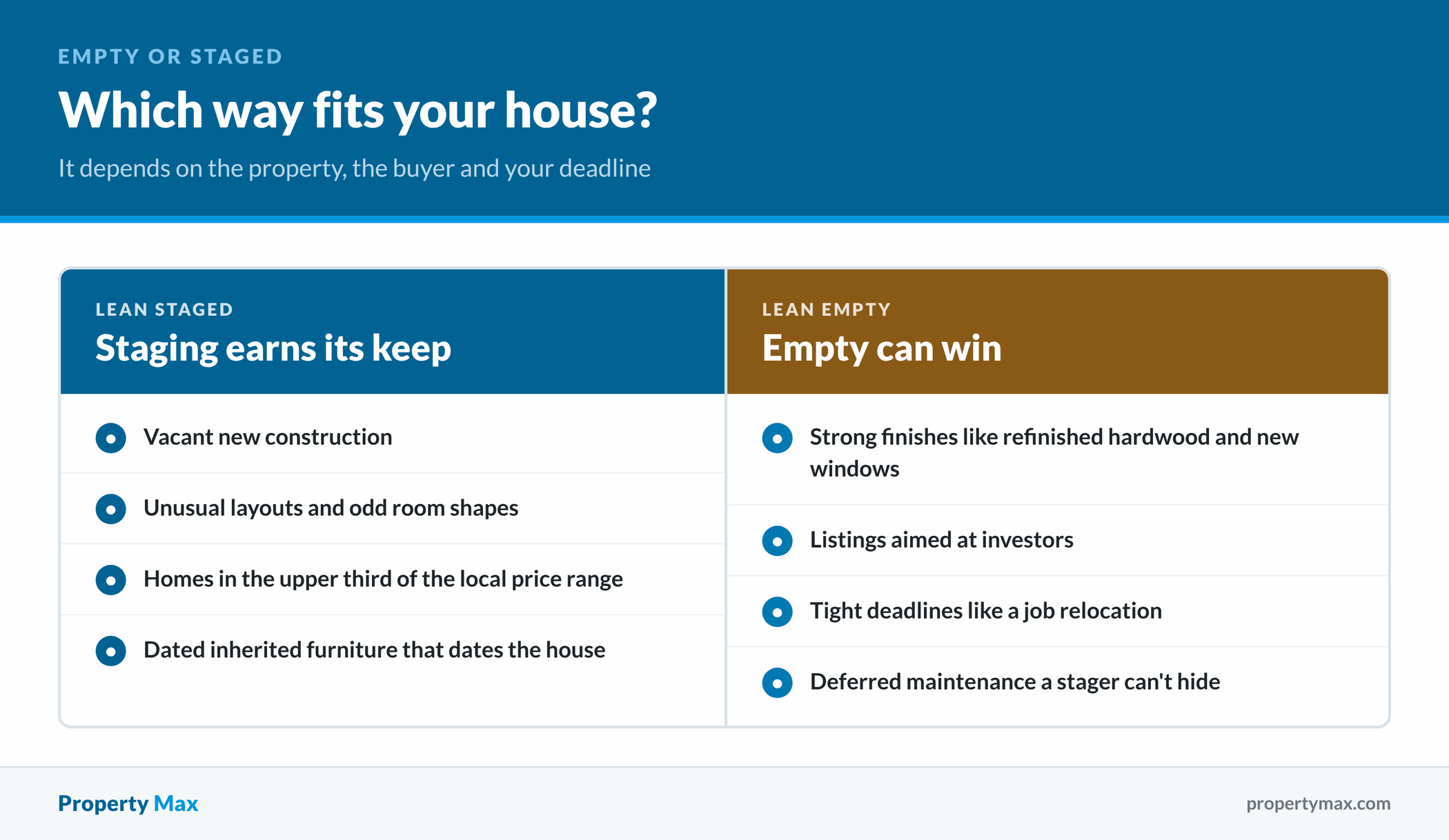
Staging pays off on vacant new construction and on odd layouts. I’d add anything priced in the top third of its market, since those buyers are shopping for a feeling as much as a floor plan.
Put a loveseat in a 10×12 living room and buyers read it as cozy. Leave it bare and they read it as cramped.
Have you looked at your listing photos the way a buyer on a phone screen would? That’s the real empty or staged test. Thumb through them fast, no context, and see whether any room makes you want to see more.
Occupied staging is the cheap version. You keep living there, a stager edits what you already own, and the cost lands closer to a consultation fee than a furniture rental. I’ve watched sellers pull 40% of their furnishings into the garage and transform a house without buying anything.
Season tips the empty or staged balance too. Winter listings fight dark afternoons and bare landscaping, so interior warmth carries more weight. Spring listings with good natural light can sometimes get by on photography alone.
One more case for staging: inherited properties where the furniture is dated enough to date the house itself. A 1970s sectional tells buyers the kitchens and bathrooms probably match, even when they don’t.
When Is an Empty House Better Than a Staged One?
Before: a four-bedroom ranch crammed with two households of furniture after a family combined homes, every bedroom doubling as storage. After: emptied out, floors refinished, listed bare, under contract in under three weeks.
Empty wins more often than the staging industry likes to admit. If your property has strong bones (refinished hardwood, new windows, fresh paint, a renovated primary bathroom), the finishes are the product and furniture just covers them up.
Buyers touring a renovated house are measuring for cabinets, not admiring your bedding.
Same goes for a listing aimed at investors. I’ve never once had a landlord ask who picked the bedspread. They want the roof’s age, the panel brand and what the place rents for.
You’ll feel cost pressure here too. Furniture rental on a vacant staging job can run a few hundred dollars per room each month while the house sits unsold. Sell in three weeks and that’s fine. Four months on the market means you’ve funded someone’s furniture business.
Empty is also faster: no install scheduling, no stager’s calendar, no waiting on a truck. For anyone selling under a deadline (job relocation, a second mortgage payment they can’t carry, a closing date on the next house), speed outranks presentation. When the clock is that short, empty or staged stops being much of a decision.
Houses with deferred maintenance belong empty as well. Staging a property with a failing HVAC system reads as a cover-up once the inspection lands, and buyers who feel oversold get aggressive at the negotiating table.
One caveat: empty does not mean dirty. An unstaged house still needs clean floors and a working bulb in every fixture. It also can’t smell like the last owner’s dog. None of that costs much, and it moves more buyers than a rented dining set does.
What Are Cheaper Alternatives to Full Home Staging?
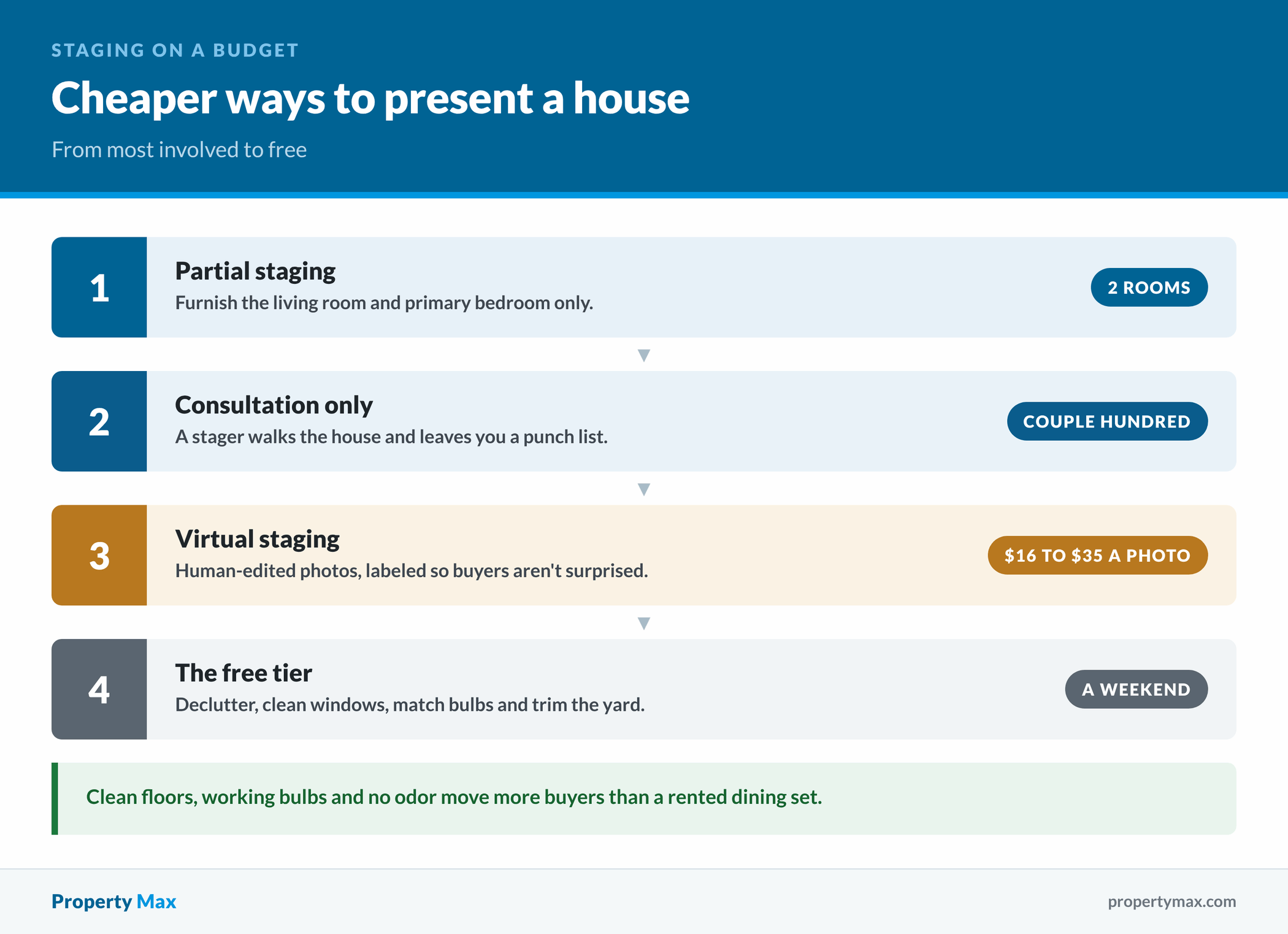
Plenty of sellers stuck on empty or staged don’t want to rent a houseful of decor, and you don’t have to.
Virtual staging got good, and it got cheap. A human editor typically charges about $16 to $35 a photo and turns the job around in a day or two. AI tools run under a dollar an image on a monthly plan. Five rooms done digitally costs less than dinner for two.
Label the photos, because buyers who show up expecting furniture and find bare floors feel tricked, and that feeling never helps a negotiation. Some state real estate commissions have rules about digitally altered listing images, so ask your agent what applies where you are.
The consultation-only route costs a couple hundred dollars in most markets. A stager walks your property, writes a punch list, and leaves. You do the work yourself, from paint colors to furniture placement to deciding what goes to storage.
Partial staging splits the difference: furnish the living room and primary bedroom only, skip the rest. Those happen to be the two rooms buyers weight most heavily anyway.
Then there’s the free tier, which people wave off too fast. Declutter hard. Get the windows clean on both sides, put the same color bulb in every lamp, and cut the shrubs back off the glass. On one street I watched a weekend of that work outperform a rented bedroom set two doors down.
Family photos come down. Kitchen counters get cleared to a coffee maker and maybe a fruit bowl, and the closets lose a third of what’s in them so they look roomy instead of crammed. It costs you a weekend and nothing else.
For sellers who’d rather skip the whole production, Property Max is worth a call before you spend a dollar on presentation.
Empty or Staged: How Do You Avoid Leaving Money on the Table?
A widow in Salem, Oregon spent three weeks agonizing over whether to stage her late husband’s house, then priced it 8% too high. Most sellers overthink empty or staged and underthink price.
Your price is the lever that matters most. Staging might nudge the sale a few percent. Overprice it against the comps, though, and the nicest living room in the zip code won’t save you. Settle the price first and worry about throw pillows later.
Second lever: photography. I’ve seen a beautifully staged house die online because somebody shot it on a phone at dusk, and I’ve seen an empty one sell off one great wide-angle shot of the kitchen. On a limited budget, spend it on the photographer before the furniture.
Third: know your buyer pool. A first-time buyer shopping a three-bedroom ranch needs help visualizing, while an investor walking the same house is counting windows and checking the water heater.
What’s your actual deadline? Not the one you’d prefer, the one your finances dictate. That answer determines more than any staging decision will.
A seller in Corvallis, Oregon reached out during a divorce, with both parties agreeing on one thing only: neither wanted to manage a listing. The house had a half-finished basement and a motorcycle still parked in the garage. Neither of them wanted to rearrange furniture for strangers. They wanted it closed, so the attorneys could divide the proceeds and everyone could move on.
For those two, empty or staged was never the question. A sale like that is about getting it finished, and treating it like a decorating problem would’ve cost them months.
Frequently Asked Questions About Selling a House Empty or Staged
What Should You Avoid Doing When Staging a House?
Don’t stage around problems. A rug over a water stain looks like a cover-up the second buyers lift the corner, and after that they don’t trust anything else in the house. Pack up the family photos and the plug-in air fresheners while you’re at it. Go easy on furniture too, because a crowded room looks smaller than it is.
Does an Empty House Always Sell for Less Money?
No. An empty house with good finishes, sharp photos and an honest price holds its own just fine. The staging bumps agents talk about mostly show up on higher-end homes, where buyers shop style as much as square footage. If your house sells on its condition or its street, bare rooms won’t cost you a thing.
How Long Does It Take to Get a House Staged?
Figure one to three weeks from booking a stager to having finished listing photos, and longer in spring. The install itself is a day or two. Mostly you’re waiting on the stager’s calendar and on whether the pieces you want are out on another job, so a tight deadline can push you toward listing empty all by itself.
Is Virtual Staging Worth It Compared to Real Furniture?
For a vacant house, usually yes. The price gap is huge, and most buyers make up their minds on a phone screen anyway. It stumbles at the showing, when somebody who loved the photos walks into empty rooms and feels a little let down, so label the photos clearly and make the real house spotless and bright.
Should I Leave Some Furniture or Empty the House Completely?
Somewhere in between usually works best. Keep a sofa, a bed and a table so buyers can judge scale, and send the rest to storage. If what’s left is worn out or straight from 1985, haul it off too, since tired furniture makes the whole house feel older.
Does Staging Matter More in a Slow Market?
It matters differently. With more houses for sale, buyers have choices, and presentation helps yours get the click and the showing. Slow markets punish overpricing harder too, so no amount of staging covers for a bad number. I’d treat it as a volume knob on a price that’s already right.
If you’re stuck on the empty or staged question and the real issue is that you’d rather not list at all, we’re happy to talk it through. No pressure, no obligation, and no one will push you toward an offer you don’t want. Sometimes twenty minutes on the phone is enough to show you which path fits.